
Loading cart contents...
Mono by Laura Parker
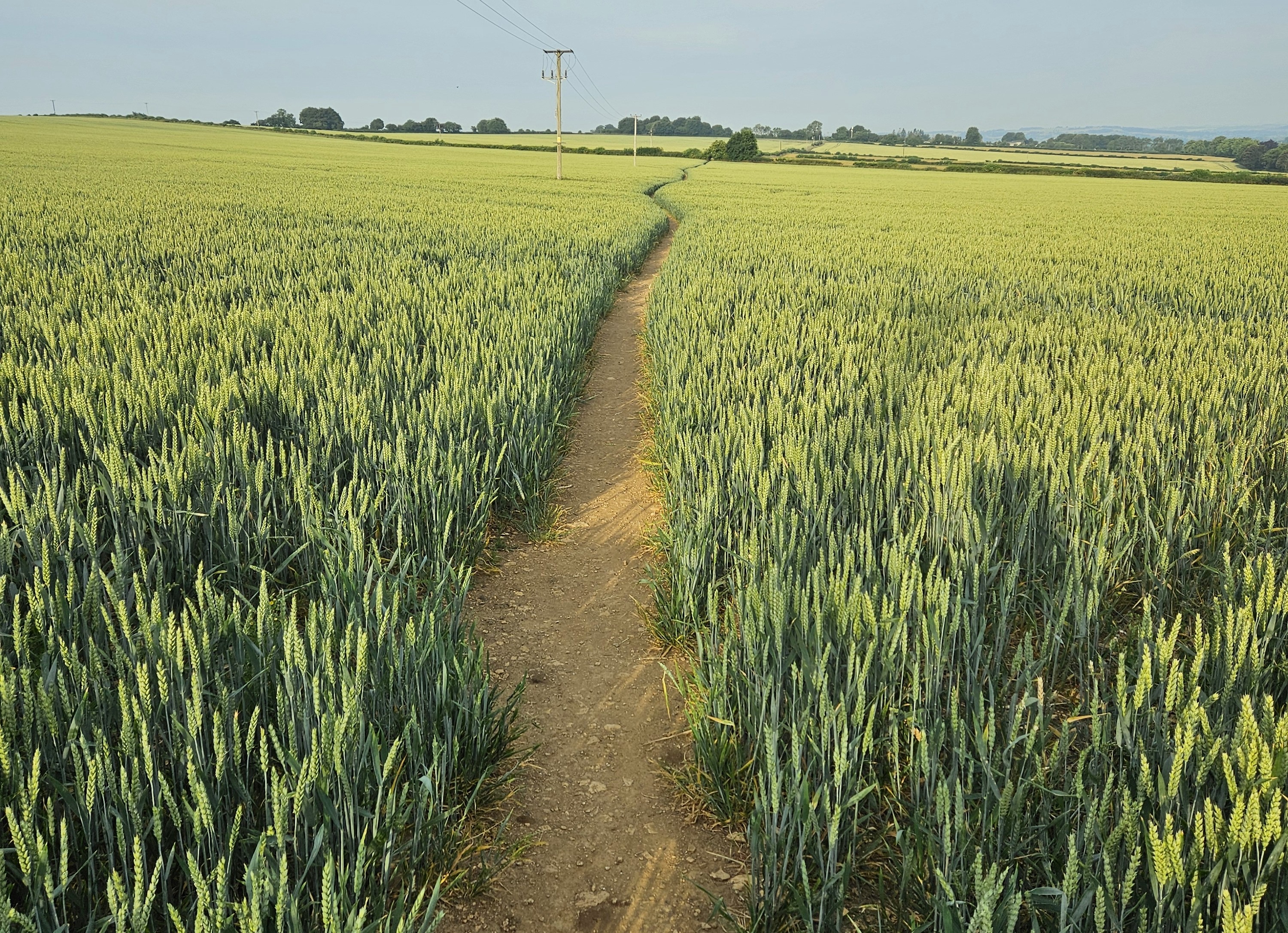
The hare, just before dawn, goes to tend to her leverets. Anxiously pawing at them to get up, she lets them feed and nuzzle at her. Together the three leap and play, dancing along the tracks of bare earth, kicking up dust. She teaches them to rise up on their hind legs to look above the plants that surround them. In the grey-filtered light, the young hares see only green blades to the horizon; one colour, one height. This is their world, their food, shelter, and cover.
*
I turned off the main road and took the narrow lane into the valley. The land unfolded below me under a bright January sky. Pulling over into a gateway, I glanced into the rear of the car where my son was strapped in his baby seat, dozing after his half day at nursery and my allotted hours in the office. It was our first winter here and this was how it looked. Sunshine on young crops and everything weirdly, dazzlingly, green.
I’d expected the south to be verdant. I’d always been struck by the difference between my Scottish homeland, with its persistent subtle fawns, ochres and purples, and the astounding lushness of dairy country glimpsed as we made our holiday drive south on the motorway. In those days I had warmed to the soothing pastures of the parkland landscapes during the obligatory stately home visits; ha-ha walls, iron fences, cattle standing in the shade under majestic trees. It was then, finally, that I was able to recognise some of the rural scenes described in that oh-so English literature: Tennyson’s immemorial elms; the lush, dripping, sticky orchards where Tess was entranced by Angel Clare’s playing; the lea that Thomas Gray’s lowing herd wound slowly o’er. But those were summer idylls.
That day’s winter prospect of the Evenlode valley was different, unnerving, empty. Field after vivid field, lining the valley like a roll of lime-coloured paper. The pattern of farming familiar to me, with its varied palette of rotational pasture, grain and root crops, had been washed over by giant machines designed to turn almost every inch into green gold.
I wound down the window to hear a lark – disconcertingly early – and the rawk of rooks. Apart from that, no sound of life. Just the continuous background of the main road, and a white van changing gear across the other side of the valley. A tractor spraying in the distance.
In the hamlet below, the cottages stood patiently and empty. At the big house, near the stables where a dung heap steamed, someone was schooling a chestnut horse, the only animal in the entire scene.
I tried to scroll my mind back to visualise previous centuries in this valley, time travelling to the 14th century like Dick Young in Daphne du Maurier’s The House on the Strand, a novel whose completely visualised landscape haunted me even though I had never visited Cornwall, where it is set. Like Dick, I would be looking down on shepherd children assigned to watch the flocks, and perhaps the man with the horse would be the steward Roger, on his way to the priory at Burford, where he might meet the 12-year-old Nicholas Fetterlock, son of a wool merchant and hero of another past favourite book about a distant land, The Wool-Pack. Might not fictional characters move location or meet others from different stories? They live in our imaginations after all.
The arrival of the golden fleece that made the Cotswold rich would have gradually transformed this valley from a clearing-dotted hunting forest to open pasture, which in turn was enclosed by the straight hedgelines. Constant improvement overlaid the palimpsest as sheep gave way to arable and the hedgerows were pulled up.
My son was waking, disoriented. I wound up the window and drove on down the road to our house in the quiet village.
In the decades since that moment of green winter wonder, I have grown used to seeing the seasons change in Mondrian-blocks of colour: yellow oilseed rape, white-blond stubble, cocoa-nibbed plough. Winter wheat and barley continue to display their viridescent early shoots.
This is now my place, the smooth featureless acres, the concreted farmyards, and the smart sheds. I’ve learned to look up, not down, for variety. Up to the big skies for the flying clouds, the high cirrus streaked through with contrails, the winter sunsets leaching carmine into mauve. But very often the Midlands skies, bereft of the large hills and coasts that direct cloud scenery changes, pull a dull grey blanket overhead.
On the farm behind our present house, a few miles from the green valley, the farmer has for the past few years planted a bird crop. The three set-aside acres are the only part of his land not under constant cultivation. Seeds from the sow thistle, mustard, dwarf sunflower and millet sustain joyous flocks of finches and linnets over the winter. Five roe deer and a muntjac browse at dusk. In late spring, the plants are all sprayed off, shocking the new dandelion constellation into fluff, and the land lies listless and yellowing just as the verges begin to brim with life. This year, with uncertainty over farm payments, the patch has been carefully harrowed into corduroy and drilled with a late wheat crop.
Late autumn is the worst time for walking, when ploughing has obliterated the footpaths. It takes a determined few walkers to slog through and reinstate the routes with their clodding feet. When the first shoots have appeared, the farmer sprays along the line of the path, drenching his own crop in poison so we know where to walk. Once it was enough to make the trail the width of one person’s steps. Now he has to make the path wider, otherwise people braid their own lines by walking three or four abreast, dogs roaming and shitting where they please. In wet years, the crop floats adrift on the lower fields as the water tries to reclaim its meadow memory.
In midsummer we march between the stiffly regimented wheat across a level horizon. Sometimes poppies or wild oats dare to make a small incursion in a corner, but soon give up. The blue-green wheat unfurls in its monotony.
The man who created this single-crop landscape won a Nobel prize. Norman Borlaug was an agricultural researcher who in 1950s Mexico bred varieties of semi-dwarf, high-yield, disease-resistant wheat. Shorter and stronger than traditional wheat, the new strains were more robust. Boosted by chemical fertiliser and more water, output could double or even triple. Borlaug’s developments in wheat and rice led to a ‘green revolution’ and appeared to solve the problem of how to feed the world’s rapidly exploding population. He was credited with saving a billion people from starvation and, by allowing intensification, preventing deforestation. By 1980, his strains of wheat were cultivated across 80 million hectares worldwide.
I learned about Norman Borlaug from Ian Wilkinson, who runs a regenerative farm at one end of the empty Evenlode valley. He has taken a slice of the green paper and roughed it up, rewiggling a river to create wetland, bringing back dragonflies and reed buntings. At Honeydale farm he grows heritage wheat, which waves tall and accommodates cornflowers and poppies. Yields are lower, but the plant is dependable, and in its broader genetic variety, more naturally disease resistant. In pasture where the sheep are mob-grazed in rotation, sainfoin sends down its long, stabilising legume roots. Both crops survived the recent searing heat and drought. The 110-acre farm keeps 30 people in employment. It has an education centre and a café, along with a community kitchen garden enterprise that feeds a hundred with a veg box scheme. A micro dairy business, run on sharing principles that allow calves to stay on the cows by having only one milking a day, gave a young farmer the chance to set up a milk and ice-cream business. Then TB came knocking. Regen-land is just as susceptible to the same stringent, not to say brutal, control measures as other farming methods. Four out of the six cows were condemned. Only one was a reactor. The other three were ‘inconclusives’, which meant they were culled anyway. The young farmer went to work as a carpenter.
Viewed from the other side of the valley, Ian’s farm is a splodgy mess of summer colours. Tall dark hedges, planted to favour insect-eating birds, surround the polytunnels. Blues and reds compete in the wildflower area. Purple knapweed lines the entrance road. Reeds, willows and yellow flag irises straggle down to the pond. Laurie Lee would recognise high summer at this place:
The grass was June high and had come up with a rush, a massed entanglement of species, crested with flowers and spears of wild wheat, and coiled with clambering vetches, the whole of it humming with blundering bees and flickering with scarlet butterflies.[1]
In May, Honeydale, now known as FarmED, hosts an interactive event with the local theatre. I go along with my now-grown-up son, joining small audience groups moving around the farm, listening to readings from the region’s writers. We hear from Flora Thompson, author of Lark Rise to Candleford and Sheila Stewart, who ghost-wrote Lifting the Latch, the memoir of Old Mont the farmhand.
Over the road from Ian’s farm, large chicken sheds carry on their business behind painted metal walls. In late January, the view across to the other side of the valley is still one of brilliant citric Borlaug green.
*
Gradually, as the young hares grow, the wheat will increase in height, turn pale. Its paired grains will rustle in the breeze. If they are lucky, the animals will be old enough to move out of the way of the great unseeing harvesting machines that can gather up a leveret lying motionless – a survival technique that has protected them for thousands of years – and spit them out with the straw and the chaff. The hares squeeze into the field margins with the rabbits, partridges and pheasants; a little too close to the hedge where the foxes have dug their earths.
***
Laura Parker is a writer living in Oxfordshire whose creative work is focused on the landscapes of the Cotswolds and of the Scottish Borders, where she grew up on a farm. She keeps sheep and regularly contributes features for Country Life magazine. Her book, Stone on Stone, the story of Britain’s drystone walls and the people who made them, is published in April 2027. Her website is here. Follow Laura on Instagram @laura_parkle .
Photograph by the author.
[1] Cider with Rosie, Laurie Lee