
Loading cart contents...
Between Sea and Sky – Rewilding Lewis by Ian Grosz
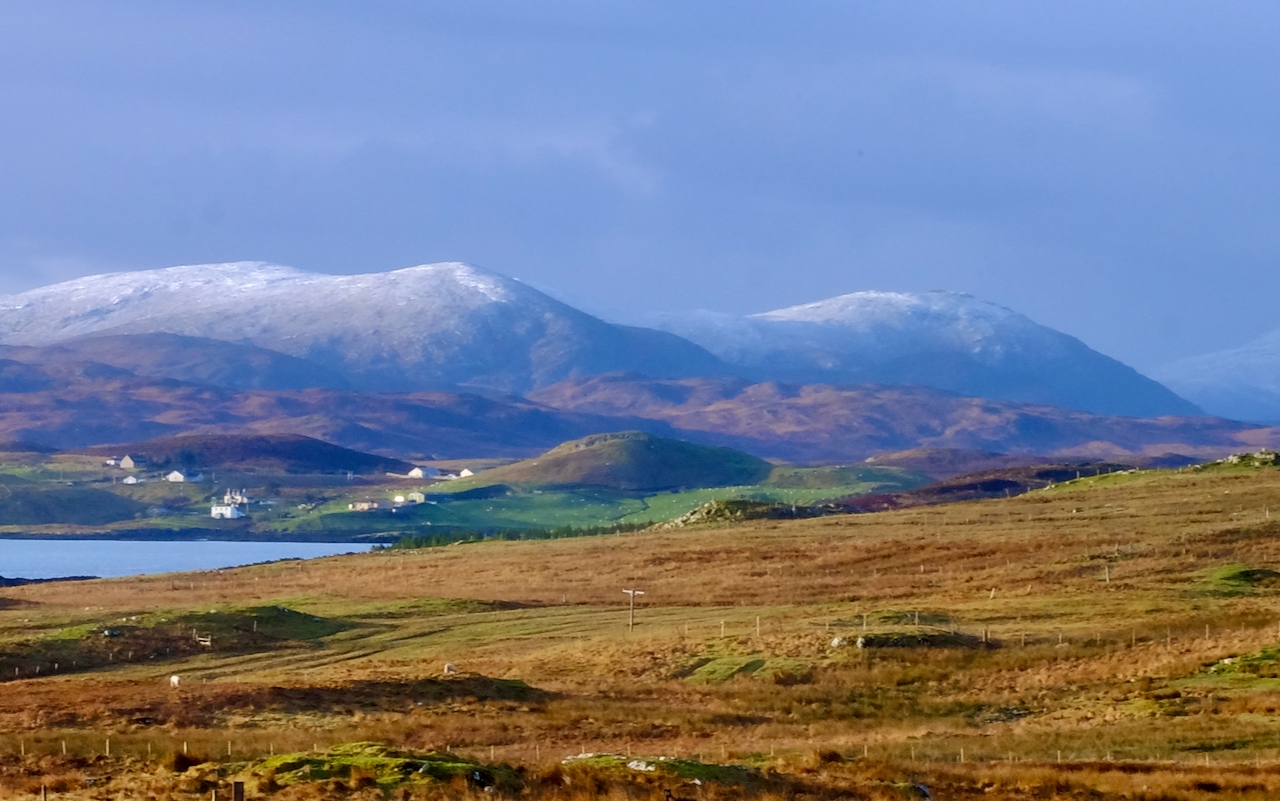
Amid squalls of sudden rain and hail, I drove west from Stornoway on the Isle of Lewis through a stark landscape of bare peat moorland. The moorland is much the same as anywhere; but the constant presence of the sea, the mountains rising timelessly out of the spray and the persistent winds which scour the moor’s treeless expanse for much of the year all bring an added sense of vulnerability that feels unique. It is not a landscape that you can ignore. It confronts you: demands that you pay it attention.
At Garrynahine (from the Gaelic Geàrraidh na h-Aibhne – ‘the green pasture land around the township of the rivers’), I took the road for the small island of Bernera off Lewis’s west coast. My destination was Kirkibost, where the poet Donald MacAulay was raised, his attachment to it ‘as fast as the limpet on the rock’; and the beach at Bosta with its Iron Age roundhouse and burial ground, described in MacAulay’s poem ‘Air Tràigh Bhòstaigh’ (On Bosta Beach), as a place where ‘the people lie – in their history.’ The dull brown of the moor was broken only by its many dark lochans and rocky outcrops, and as I headed south from the township, I felt a palpable pang of melancholy.
The road crossed the Blackwater and Grimersta rivers that spill out of the moor and into the sea loch that separates Great Bernera from the main island, the relentless boglands eventually giving way to high tors and hills. At the turn-off for Bernera, a wind-scoured wooden sign read ‘Island of Adventure’; beneath it a much more faded ‘Sea Trips.’ I took the turning and followed the undulating single-track road along the shores of Loch Ròg an Ear. A white-tailed eagle was soaring along a low ridge of granite ahead of me. I shadowed it for a mile or two, until finally, it drifted out toward the loch and dipped below the hills.
I crossed into Great Bernera via the newly built car-bridge, taking the narrow, twisting road along the shore to Kirkibost, its houses scattered along the length of the road like so many tossed pebbles left there by the tide. The name is Norse in origin and means ‘Settlement of the Church’. The dual language signs spell the name circebost and is an example of Lewis’s curious mix of Gaelicised Old Norse derived names and their English phonetic equivalents: a collision of cultures out on the western Atlantic fringe.
The pier at the end of the road harboured a dredger and a few small work boats. The sea beyond the head of the loch was wild, the wind buffeting my old campervan and whistling around the ill-fitting window seals. I thought of MacAulay’s nostalgic poem, ‘Circeabost: an Ceann a Deas 2000’ (‘Kirkibost: The South End 2000’), recalling the familiar and reassuring places of childhood – ‘The Brae of the Hazel and the Lower Enclosure / The Red Homestead and The Heel of the Hillock’ – but that homely sentiment felt remote to me as a passing winter visitor, and I couldn’t span the distance between my experience and MacAulay inside his poem. Most of the houses in the township seemed less agricultural and more kept, and I wondered how many might be second homes.
At the turn-off to Bosta, I saw a monument perched on a rocky outcrop above the road. I parked up to take a look, discovering that it commemorated the Bernera ‘riot’ of 1874. Some googling revealed that the ‘riot’ actually refers to a court case when the people of Bernera successfully fought the Matheson estate after a series of heavy-handed evictions and the clearing of the common grazing grounds to make way for a shooting and hunting estate by the estate’s lawyer, Donald Munro. It was the first successful action taken by crofters in what became known as the Crofters’ War: a succession of acts of resistance against wealthy Highland landowners, which eventually resulted in the land reform enshrined by the Crofters Act of 1886, giving crofters rights to protected tenancy.
An old photograph of Munro revealed a heavy-set man with a large moustache growing into his sideburns, as was fashionable at the time, posing with a huge club, or ‘chib,’ undoubtedly used in carrying out his duties. Louis MacNeice, visiting the islands in 1937, described in his travelogue, I Crossed the Minch, how Munro would ‘stride through the land, saying “I’ll have the croft off ye”.’ After the trial, Munro was removed from his position and stripped of his offices. He died alone and unlamented some years later.
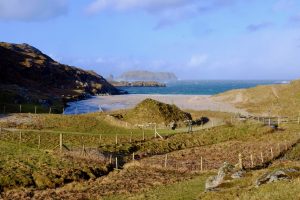
I drove on to the beach, passing once more through the unrelenting landscape of moorland and lochan and arriving at a small car park above the bay with its sad-looking burial ground set back from the dunes. I could barely open the van’s door against the wind. Hanging on, literally, to my hat, I had to push against the door with my knee and right shoulder, quickly pulling up my hood once outside. I made my way down a muddy track through the dunes and was greeted by the sight of the bay in a moment of sunshine between the showers of sleet and hail.
The Atlantic glimmered an intense blue-green capped with foam, waves relentlessly rolling in and disintegrating on the beach, hissing above the wind. The island of Little Bernera, mirage-like in the diffuse light created by continual spray, seemed a mythic vision on the horizon, waves sent spuming high in the air as they pounded the island’s western shore. I was left breathless by the wind – and the view – and Lewis took on a suddenly different feel: an awe-inspiring island of sense and frightening clarity; a lost world of elements; a dreamed-of place caught between sea and sky.
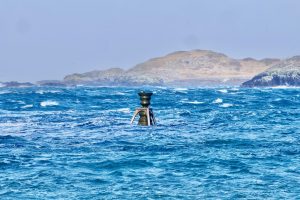
Sitting proud of the waves was a curious looking sculpture: one of Marcus Vergette and Neil MacLachlan’s ‘Time and Tide’ bells. Sculptor Vergette, and bell designer MacLachlan, have installed a series of bells in various coastal locations to highlight the impact of global warming and the threat of rising sea levels. The project has so far taken over a decade, with new sites planned and bells in situ around the coast of Britain from Devon to this beach in the Outer Hebrides. Each location has been chosen through connections with community: a way, the artists say, to help communities think about their identity in a century of reassessment of who we are as a people and where we might fit in with the natural world.
I listened for the bell but could hear only the wind, the waves meeting the shore, and clambered up the rocks at the back of the beach before making my way down boggy slopes toward the reconstructed Iron Age roundhouse nestled in the dunes. After a storm in the early 1990s uncovered the remains of a dwelling, excavation revealed a collection of eight Iron Age Pictish houses beneath a later Norse settlement. The contents of the houses had been perfectly preserved in the sand, making it possible to reconstruct a picture of daily life for Bosta’s early inhabitants.
The Iron Age people here fished and collected crab and clams; ate seabirds and kept cattle and sheep; used antler combs and bone pins to secure their garments; and perhaps later even traded with the first of the Nordic visitors. The Norse who eventually settled built more extensively; grew crops of barley, oats and rye; farmed cattle, goats and sheep; and possibly controlled the local deer population by building a dyke between Bernera and Lewis to prevent the herd from swimming the short stretch of water in the sound between them. The name Bosta is the product of the phonetic spelling of Bostadh, which is a likely Gaelicised corruption of Bólstaðr meaning ‘farm’ in Old Norse.
The later Gaelic-speaking inhabitants already lived in a treeless landscape, cleared in successive waves of settlement and farming. They sheltered in the low turf-roofed Black Houses the island is now famous for, sharing their dwellings with their animals. A shortage of fuel eventually forced an abandonment of the site in 1875, and the graves of some of its nineteenth-century inhabitants in the dunes was a poignant sight: a people laid to rest close to the buried Iron Age settlement of their forebears and the ocean that had shaped them. Just as MacAulay says in his poem, the people here ‘lie – in their history.’
Lewis’s layering of time and people are laid bare at Bostadh: a mix of Pictish, Norse and Gaelic heritage; the nearby famous stones of Callanish the remnant of the Neolithic people who came before them and first began to clear the trees. I wondered if we would eventually follow suit: lying in our own collective histories of habitat destruction, pollution, global warming and war, the remnants of our cities there to be discovered by some future team of archaeologists trying to understand what had happened. I left the settlement at Bostadh and headed for Carloway to meet with a modern-day crofter: another ‘incomer’ who had managed to make this island home.
*
Susanne Erbida hurried up her driveway with an energetic collie in tow. The morning sleet and hail had abated but the wind was still fierce. It almost carried her up the slope of her drive as she approached. Laughing as she greeted me, she told me her power was out, and led me to her barn above the house.
Susanne was originally from Austria but had bought a croft with a plot of land in Carloway on Lewis’s west coast in 2021 after living for five years in Stornoway. The croft covered three or four acres in a long strip running from the shore of the loch beneath the house and up onto the moor. It seemed a lot to manage.
‘The idea is to plant a forest, woodland,’ she told me. ‘And to grow some vegetables, fruit. I have already planted some bushes here at the sides to provide a shelter belt,’ she said, pointing out a row of young saplings running down toward the house. ‘Apples do well here.’ She was full of energy and enthusiasm.
‘What made you choose to grow woodland?’ I asked.
‘Because there are no trees around here,’ she said flatly, as though I had asked a stupid question. We both laughed.
‘I mean, I want to basically re-wild the land here,’ she added.
‘Your own land, or wider than that?’ I asked her.
‘Well, make a start,’ she said. ‘There are other people planting trees here. About two-thousand trees have already been planted.’
Much of the island was once covered by mixed woodland. After the ice sheets retreated at the end of the last ice age, the dry Arctic climate became relatively warm and wet, influenced by the Gulf Stream. This allowed peat to begin to form in the ice-scoured basins and wide plateaus left behind. The peat that had accumulated by the Neolithic provided a ready source of fuel, and the practice of settled farming led to the gradual clearance of tree-cover and the spread of grasslands for grazing. Almost all of the woodland cover was subsequently lost in successive periods of settlement and the peat formation accelerated until Lewis’s landscape eventually became dominated by the bare peat moorland that characterises it today.
Peatlands are nevertheless among the most vulnerable and important habitats on earth, together absorbing an estimated 370-million tonnes of carbon dioxide annually. The carbon held in Scotland’s peatlands as a whole is equivalent to the last hundred years of the country’s emissions from the burning of fossil fuels. If these peatlands are damaged or dry out, there is an obvious knock-on-effect for global warming. I asked Susanne about the impact of planting trees on an island that is so extensively covered by peat.
‘There’s a lot of nicely grazed ground here that’s perfect for planting,’ she told me, pointing out that crofting land on the fringes of the moor had been used largely to keep sheep. ‘Sheep have grazed here for over a hundred and thirty years. The Woodland Trust is doing a lot of work. I’m getting my trees from them.’
Crofts in Scotland account for 750,000 hectares of land: around 15% of the total landmass of the UK. The Woodland Trust is working with crofters across the Highlands and Islands to help establish native woodland on crofting land no longer used for sheep grazing: a scheme to help re-establish the tree cover and combat climate change. The Trust offers funding to help support the scheme as well as advice and training for crofters looking to plant trees. Susanne planned to make use of her land this way, rather than to keep sheep as a traditional crofter might.
I asked why some crofters still keep sheep on such a small scale; whether it was more of a tradition than a viable way to supplement income.
‘That’s the only reason,’ she said. ‘You can’t make money at all. If anything, you actually lose money.’
Susanne told me that keeping sheep was to preserve a way of life that connected traditional crofters to the past – to the gathering in of the sheep from the common grazing with their sheepdogs; congregating at the shielings to talk and to do the shearing; going through the annual cycle of lambing and market that goes back centuries. ‘Most of the people who keep sheep here are older people, pensioners, and they literally just keep ten or fifteen sheep, maybe,’ she said.
It was a relief to duck out of the wind and into the barn, but the guttering against its metal frame was making some alarming noises. Susanne’s chickens clucked away, oblivious, scratching around in the straw in their winter enclosure at the back.
I asked Susanne how she came to buy the croft. I had understood they were usually passed down through families on the island.
‘A lot of them are,’ she said. ‘But sometimes whoever has them can’t keep them up anymore. Many crofts have lain empty for decades because nobody wants them, but it’s still really hard to get a croft.’
‘Why is that?’ I asked.
‘There just aren’t that many available. There’s just not enough on the market,’ she told me. ‘And it’s expensive. You can’t get a mortgage on a croft. You have to be able to buy them outright. People from the mainland have been coming over and buying up the property, buying the old crofts, and it’s been pushing up the prices and nobody local can afford them because these buyers just overbid on them, and locals can’t compete.’
Susanne became visibly annoyed. ‘They do one winter and then realise they can’t cope,’ she said. ‘And the house becomes another second home or an Air BnB.’ Her expression softened a little. ‘We were lucky,’ she said. ‘Last year, in summer, we were looking for a house and I saw this – the first one we saw actually – and got the home report and found out it belonged to our neighbour in Stornoway. So, we asked him and he said, “yeah, if you take it on I can give you a good price”, and we were just very lucky.’
By now the wind had really picked up and it was becoming difficult to hear each other above the noise, so we went back down the slope to the house, buffeted constantly by the wind. Susanne talked about the trees she had already planted as we walked. There was dogwood, hawthorn and blackthorn around the perimeter, which would transform the croft from an open slope with its exposed house to a much more private, sheltered space. We hurried inside, and as we sat at the kitchen table, I asked her what she missed most about the islands when she went to the mainland.
‘The peace and quiet,’ she told me. ‘And there is less pressure here. In the city you have the constant consumerism pushed into your face,’ she said. ‘All the time – “buy, buy, buy” – all the shops. It just…it just got too much. There is so much more there, culturally – a lot more choice – but it just…gets claustrophobic. I’m not missing it.’
I asked if she could tell me what it was that made her feel at home on Lewis.
‘I own my own piece of land. I can live how I want here,’ she told me. ‘I can fulfil my dream here. I wouldn’t be able to do that in Austria.’ She paused again for a moment, looking out of the kitchen window. ‘I love the landscape here,’ she said, her eyes alive with an obvious passion. ‘I love the stones and the soil and everything, to see how it changes in the seasons. I can’t wait for all the trees to be there. I love just walking out beyond my croft out onto the moors with all its rocky outcrops, all the old buildings from the previous crofting generations there, the old shielings.’
I was struck by Susanne’s deep sense of connection with her croft and to the land, and what she had found there: a life and a way of life that does not follow the old, traditional ways, but a new way of life that still honoured the memory of the people that came before her: the people still present in the land. She asked if I’d like to walk the croft with her, and so we wrapped up again in our coats and hats and headed back out into the wind, Susanne’s collie rushing past us.
I followed them both across the narrow road that winds its way around the shore of the loch, walking uphill and past the barn, its gutters still scraping noisily against the metal frame. As we reached the rise of a rocky knoll, the land of Susanne’s croft stretching on before us, she paused to tell me that the hill below, on which her modern barn now stands, was called Cnoc Ailean: Alan’s hill. We dropped down the far side of the knoll, Susanne’s collie bounding on ahead of us and the wind carrying our voices quickly away across the moor.
***
Ian Grosz lives in Aberdeenshire in the northeast of Scotland. He writes about landscapes, people and places, and is the host of the Paperboats Writers Podcast.
Photographs courtesy of the author.