Loading cart contents...
New poems from David Troupes, Katherine Robinson and Robert Okaji
‘Some seeds are buried, others scattered.’
Poems by three American poets on landscapes close to their heart.
Indian Brook by David Troupes
A looking glass—a black gutter
hurrying the season’s dark product.
Stopping, searching,
we see ourselves, sunless bloom
tangled in the water
among crayfish,
below October’s colors and contusions. An old heart
drifting by in the water-play.
An old eye.
As by a fingertip gesture the trees
pass their leaves
to the brook. Sun retreats
but sun-smell remains, and the cloud
mounting to the west
is a door shut to keep a room warm.
Self and self:
gone and gone. Old joys
of the autumn-swallowed acres: goat’s ears,
stones the sun found, and the fishing bridge
and fire-nook. Rain on the hills—
quick in the creases, slow
in the swamp-boles—
draws our chin to our heart, and our wandering
singly
to a sea-root.
Insomnia by Katherine Robinson
Out walking, you’d stop to rest
on a hemlock log
beside a No Trespassing sign.
You looked up at the balsam-studded slope
you still could tell me was a moraine,
heaped by retreating glaciers,
and you recited Robert Frost.
You’d pause, then begin the poem again,
forgetting you’d ever started.
Whose woods these are I think I know.
His house is in the valley though,
you’d carefully repeat.
Frost’s village became, in your memory,
the valley that you loved,
and the poem absorbed the place
you’d driven down to every afternoon
to get your mail: a single road
surrounded by mountains.
On an index card
you wrote that death would be like sleep—
instinctive after a long day,
although sleep, for you, was never easy.
Without the pills beside your bed,
you read all night,
or wandered from kitchen
to television to piano,
restless although you’d climbed for hours.
You kept that card in your bedside drawer,
beneath the rattling stones
you’d carried home from Himalayan glaciers—
small association offered up
into whatever goes on endlessly,
refusing us all entry
until it irrevocably is our own,
where we hope to find
some part of what we were.
Prescribed by Robert Okaji
Some seeds are buried, others scattered.
April’s wildflower reflects October’s rain.
Bluebonnet, fragrant gaillardia. Texas paintbrush.
Cause and effect is seldom so clear with people.
Left hand offers money, right strikes a match
and the voice sings praise without conviction.
Perhaps we are guileless,
and true motive lies in the completed deed,
underground or above,
blossoming or charred after the burn.
DAVID TROUPES is a Massachusetts native in the final throes of a PhD at the University of Sheffield. He has published two full collections of poetry, Parsimony (2009) and The Simple Men (2012), the latter of which garnered a long-list nod in the Forward Prize. His work has appeared in a variety of journals on both sides of the Atlantic, and was featured in Carcanet’s 2015 anthology New Poetries VI. He is currently a Fellow of the Jerwood Opera Writing Program. See www.buttercupfestival.com for more information.
KATHERINE ROBINSON’S poetry, fiction, and essays have appeared in The Kenyon Review, Ploughshares, The Hudson Review, Poetry Ireland, Poetry Wales, and elsewhere. She holds an MFA in poetry from Johns Hopkins University, and she is currently pursuing a PhD at Cambridge University where she studies the influence of The Mabinogion, a collection of Medieval Welsh tales, on the poetry of Ted Hughes.
ROBERT OKAJI’S most recent chapbook, From Every Moment a Second, is available through Finishing Line Press. He is a regular contributor on Vox Populi, and his work has appeared or is forthcoming in Crannóg, Oxidant|Engine, Panoply, Wildness, Taos Journal of International Poetry & Art, and elsewhere. Visit his blog, O at the Edges, at http://robertokaji.com/.
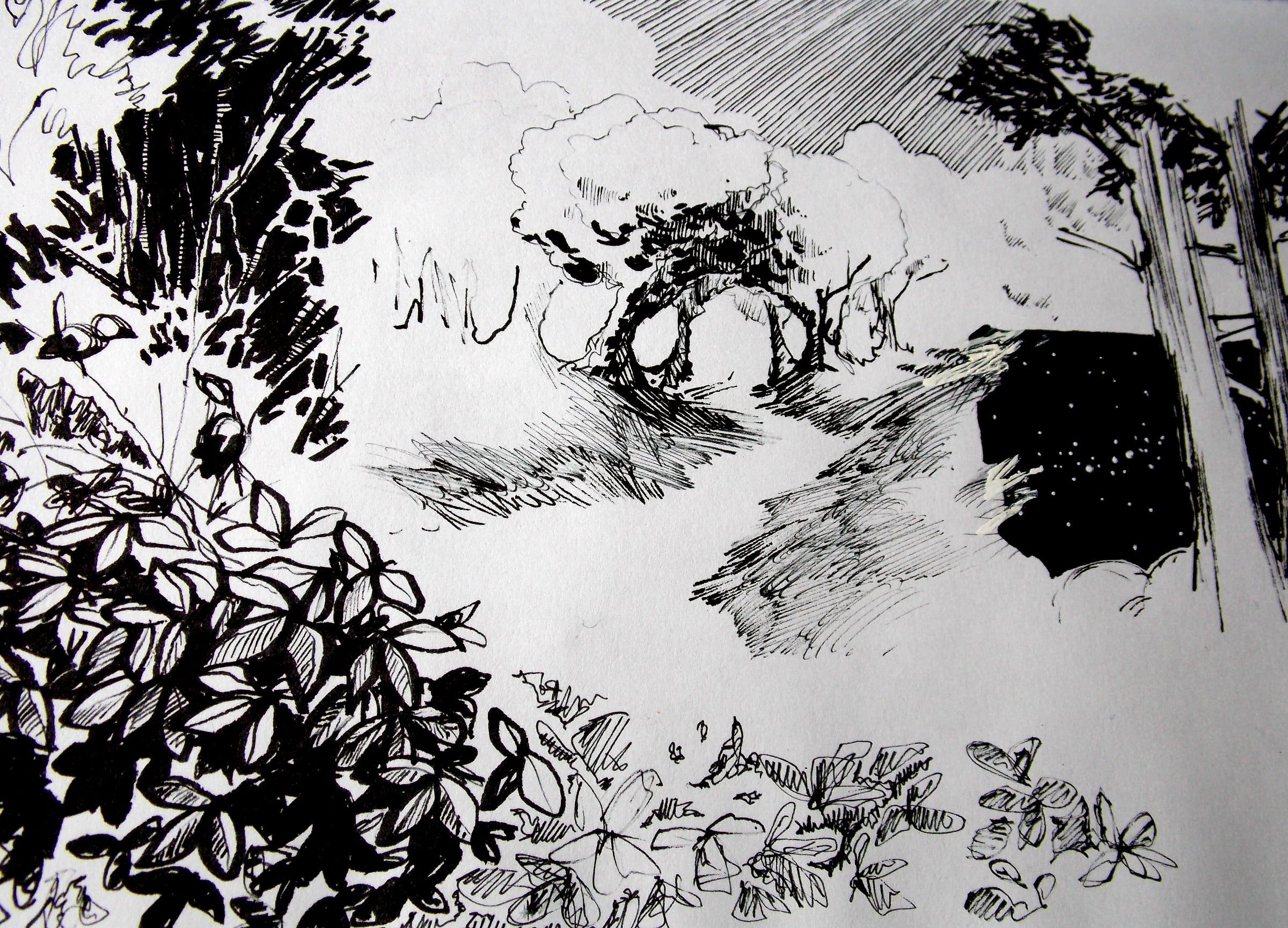
Illustration by David Troupes: ‘Indian Brook, Massachusetts’.
3 Comments
Join the discussion and tell us your opinion.
A great poem, Robert! I had to think as I read, Some people are buried and some are scattered as well. Plants unlike people are not pretentious.
Dwight
So true about the plants, Dwight. Thank you.
“Left hand offers money, right strikes a match
and the voice sings praise without conviction.”
I love how you go, how you’ve gone. It’s always a pleasure/ Thanx again, gray