
Loading cart contents...
Harry and Pierse by Hana Loftus
The emptiness of the farming landscape today – a few people and many tractors enough for hundreds of acres – stands, in the popular memory, by contrast to an imagined past of smoke rising from cottages, busy fields and villages where life may have been simple, but which thrummed with a rich community life. The ravages of globalised trade driving British farmers into the ground, barely able to break even against cheap imports, sounds like a late twentieth-century phenomenon. But the opening up of the American prairies in the late 1870s, along with fast railway lines and steam shipping, swamped the British islands with cheap food, leaving tenant farmers unable to afford their rents, and thousands of workers migrating city-wards in an agricultural crisis of huge proportions and lasting impact. Acres of land became waste, estates bankrupted and broken up, and those tenants and labourers left on the land subsisted in deep poverty. Between 1881 and 1911 the number of farm workers in East Anglia fell by a fifth, with a thousand-acre farm supporting perhaps only twenty families. Worse was to come after the subsidies for wheat prices and agricultural wages during the Great War – generating a shortlived boom as fallow fields were quickly brought back under plough – were abruptly cancelled as the costs spiralled – the so-called’ Great Betrayal’ which saw prices plummet, small farmers bankrupted and land abandoned once again.
Yet the cheapness of land brought with it opportunities. Wealthy industrialists with no need of a farming income bought up trophy estates for golf and house parties, and built grand houses staffed by dozens of servants. The seaside resorts of Southwold and Aldeburgh attracted affluent, fun-loving Londoners; the marginal breckland soils of the coastal fringe were developed with terraces of ornate villas at Felixstowe and the arts-and-crafts fantasy village of Thorpeness; while Walberswick already had a reputation as a bohemian artists’ bolthole. It was to this deeply divided east Suffolk that the artist Harry Becker moved in 1912 with his wife and daughter, after the early death of his son.
Becker – the son of a German-born doctor – had a cosmopolitan education, studying in Antwerp from the age of fourteen at the painting school where Van Gogh would enrol a year after he left, and then in Paris. He had sold-out exhibitions of in Bayswater and Mayfair, exhibited alongside Walter Sickert at the New English Art Club and the Salon des Indépendants, and in 1911 his painting Dutch Peasant Women Gathering Potatoes was chosen as one of the Royal Academy’s pictures of the year. His sudden retreat to Suffolk killed his commercial career, and placed him on the knife-edge between the carefree culture of the late Edwardian bourgeoisie and the poverty of the agricultural working class. He spent the rest of his life, until his death from pneumonia at the age of 63, crouching in the fields, scrawling obsessively on scraps of paper, and taking his drawings home at dusk to be translated into thick brushstrokes of oil, and lithographs that have all the immediacy of a sketch from life.
At a century’s distance, Becker’s fluid drawings, lithographs and bold oil paintings might, at first glance, belong to an idealised lost rustic world, just as in Constable it is too easy to miss the evidence of the decay and cracking social ties of a previous agricultural depression when it is surmounted by such heavenly clouds. But unlike Constable, and unlike Becker’s own contemporaries, his work is not of the landscape, first and foremost, but of the workers who are tied to it. There is none of Lucien Pissarro’s picturesque play of light over fields and trees, or the loose lushness of Duncan Grant’s landscapes where, if a figure is present, it is purely for scale. Becker’s workers are the primary subject: captured from the ground, digging, sowing, ploughing and resting; the artist looking up into faces shaded by the brims of hats, figures tall against expanses of soil that reach nearly to the top edge of the picture plane, or silhouetted above the flat horizon. The angles are photographic, the gaze unfiltered, almost intrusive at times: closer to Walker Evans’s photographs of Southern sharecroppers than the genre paintings of the artistic circles with which Becker had associated in London.
As his isolation deepened, Becker increasingly refused to exhibit, and even to sell his work, claiming it was not sufficiently valued. But he found an unlikely patron in a local brewery owner, Pierse Loftus, and his wife Dorothy, who lived the in affluent comfort in a Regency villa in nearby Southwold. Dorothy was a product of exactly the kind of Edwardian culture that Becker had so decisively turned against. The daughter of a prosperous silk broker, she had private art lessons before studying in Zurich and travelling in comfortably unconventional style to consort with artists in Rome, including the future Futurist Gino Severini who was, at the time, still painting landscapes and portraits in a Pissarro-like style. Returning to England, she made a successful professional career drawing pastel portraits of her social equals while partying at the Chelsea Arts Club and exhibiting in Bond Street, before marrying Pierse – my great-grandfather – and moving to Suffolk in 1912.
It appears to have been Dorothy who befriended Georgina while her husband was away at war (initially as a musketry instructor), helping the older woman obtain a much-needed salary as an art teacher at a local girls school. Dorothy moved easily between London and Suffolk society but her husband was not such a comfortable insider. For Pierse was an Irish Catholic, an early Sinn Fein supporter, and a Conservative of such unorthodox bent that the Daily Herald stated, in a review of his first book, The Conservative Party and the Future, that he would surely soon become a Socialist. Having attempted to stand as a parliamentary candidate in Kilkenny – his childhood county – for the Irish Nationalist Party, he spent twenty years attempting to insert himself into local politics. He advocated for House of Lords reform, ‘Land and Houses for the people’, and votes for women, but more than these unconventional views it was his Catholicism, and his Irishness, that stood in his way with the local party – no matter his commercial success. (Finally, in 1934, he was elected to the working-class seat of Lowestoft, where he campaigned for support for the herring fishery, and then to limit Sunday trading for the first time, in order that working families were able to enjoy a day of rest together.)
After Pierse returned from the Great War where, inevitably, he had wound up serving at the front, he never – like so many – spoke of his experiences, but was darkened. I wonder about the friendship that developed between the artist son of a German immigrant and the Irish-born businessman whose birth surname was Murphy. Letters speak of visits; I imagine them sitting in the cramped cottages Becker rented, or walking out into the fields and marshes behind the big Loftus house, leaving the chatter of the drawing room and the tennis courts behind.
Harry was ten years older than Pierse, and the younger man – behind his confident exterior – was prone to an anxious pessimism: his commercial drive was generated by a precarious upbringing. He was born on a heavily mortgaged estate in Ireland which was finally bankrupted by the same crash in wheat prices as had laid waste to the fields of East Anglia, and his mother (one of the ‘crazy Creaghs of County Clare’) was widowed at 36, when Pierse – the youngest of five – was only four years old. His only memory of his father was seeing his corpse – “a still, bearded figure on a bed.” Belinda turned herself into a farmer, leasing back a portion of the estate land from its new owners and raising cattle and pigs, before finding luck in the guise of a wealthy Belfast mill-owner and investor who became her second husband. The unsparing rawness with which Becker recorded the thick mud clogging around the boots of men and the hooves of the heavy, sweating horses, and the backbreaking work of women picking potatoes on their knees, may have reminded Pierse of the Ireland he had left behind. Equally, while Becker documented men who escaped call-up as the vital suppliers of food for the nation, the endlessly exhausting physical work, the mud, and the relationship between man and horse recall the Western Front. In his paintings, dun-clad legs merge into dun-coloured clay; men struggle through clods that pull them to the ground; faces are in shadow beneath caps pulled low.
What is known is that Pierse’s support for Becker went beyond the good offices of Dorothy with Georgina. He bought a huge number of Becker’s paintings, organised a large selling exhibition in one of his hotels in 1925, and paid his rent several times when the family were facing eviction. After Harry’s death in 1928, Pierse continued to support Georgina financially for the next twenty years. His son Nico, a capable amateur painter whose style shows the Becker influence, took up the baton by buying more of Becker’s works from Georgina, a stream of much-needed income until her own death in 1958. She left the remainder of Harry’s unsold works – finished and unfinished – to Nico and his wife Prue, my grandmother. (Our family are now auctioning the remainder in Colchester, Harry’s birthplace: there are only so many that my cousins and I can hang on our walls.)
What drew Becker to crouch in the fields day after day, obsessively documenting his neighbours as they worked, and while Georgina kept the family going by teaching? Because it was, truly, an obsession, when you realise the sheer quantity of drawings, watercolours and unfinished paintings he left at his death. It was a selfish, strange existence: so poor that he could not afford paper and drew on the back of sketches by his wife’s students, sitting daily in the penetrating wind of east Suffolk’s flat fields before retreating indoors to paint and etch. The Camden Town and Bloomsbury groups endlessly painted each other, their children and their friends in a circle of self-obsession. Becker’s figures are, now, nameless: the men and women of the village, his neighbours, who gradually came to accept his unceasing presence alongside them as they worked. While Dorothy left charming light-filled portraits of her husband and her children, Becker rarely sketched Georgina and Janet, and seems never to have painted them.
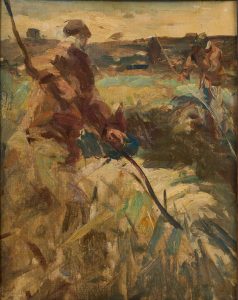
Becker recorded an unflinching portrayal of working-class rural life at its lowest ebb. The works speak of respect for hard manual labour, sometimes reaching a heroic quality: but with no soft-focus romanticism. In sketch after sketch, his strong scribbled lines capture the shapes of work – the endless bending to scythe or sow or pick, the bowed heads, the standing for a moment of rest, wiping a brow. Horses stand solid, patient, well-fed beside lean human figures. In paint, Becker’s colour palette is surprisingly bold, his brushstrokes fast and wide with the same scribbled energy as his drawings. Arms catch the light in the pink of a puddle on the field margin or the trunk of a tree. Blues echo across horse-collars, reeds, a neckerchief. Only occasionally is there a landscape unpeopled: a view from a high point, sky and land dividing the page between them.
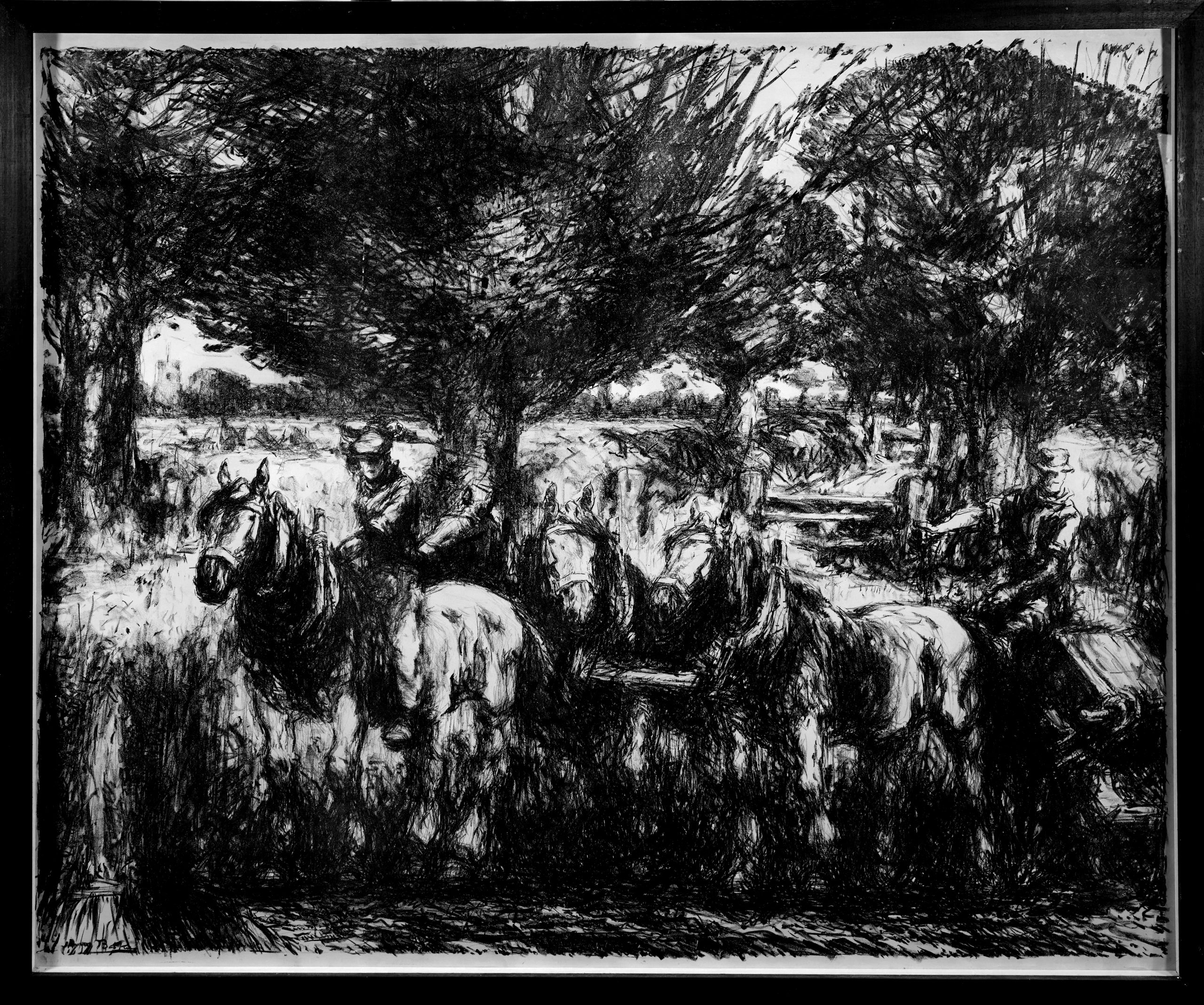
Dorothy continued to paint professionally and kept up a wide circle of cultured friends, including the likes of Walter ‘Pink’ Crittall, the industrialist and ardent Modernist behind the Silver End estate, and a trained painter himself, and the so-called ‘Sole Bay Group’ he formed around his holiday home in Walberswick. But Becker shunned the cultivation of the potential local patrons in her circle. His last remaining supporter in London was Frank Pick, the legendary designer of the London Underground map and graphic identity. Pick paid Becker in 1923, five years before his death, for his final major commission – a huge lithograph, meant for a for a poster to advertise trips to the countryside, showing a team of horses and their driver stopping for a moment at a field edge, in the shade of a huge tree.
Three feet tall and four feet wide, it is a dense mass of black lines with only glimpses of light on the sheened haunches of the horses, the cap of their driver, and fragments of the field beyond. The blackness – scrawled and scrubbed, rather than neatly hatched, summons a powerful sensation of the August midday heat and the brief respite of the cool shade. The horses’ legs disappear into darkness, and the canopy of the trees obscures the sky.
***
Hana Loftus is a designer, planner and writer who lives and works in Essex. Her first book, Sixteen Acres, was shortlisted for the Fitzcarraldo Essay Prize in 2025 and will be published by Profile in spring 2027. Read more on her website.
The image at the head of this essay is The Binder Team (1923), Harry Becker Estate Collection,