
Loading cart contents...
Calling Time by David Hinchliffe Bradford
Last year, for the first time in my life, I did not hear a cuckoo. I say for the first time, but of course I can’t be sure. It’s not as though I’d kept a tally for the previous forty-two years. But I am certain that through the spring and summer of 2025 I did not hear its call, not once. Why only now was I attentive to its absence?
There are two possible explanations. The first is age. I was brought up short by a recent interview with the film director Chloe Zhao. ‘When you’re in your forties,’ she said, ‘your body is changing, and you can feel death.’ She was grateful for this feeling, she explained, as it had prompted a reckoning. ‘Because I’m so scared of [death], I have no choice but to develop a healthier relationship with it, otherwise the second half of life will be too hard.’ I was about to turn 44, and I knew what she meant. Death is not only a feeling in the body for me, but an hourglass at the back of my eyes.
It is exactly 20 years since I was diagnosed with retinitis pigmentosa (RP), a genetic glitch that is slowly destroying my retinas. I am lucky, relative to others with more aggressive forms of RP, that my central vision remains quite good. Beyond the central maculas, though, my retinas are toxic wastelands—clumps of dead and dying rod cells conveying to my brain a dissolving periphery of swirling, shimmering chaos. Each year a sliver more of my visual field ebbs invisibly away like soil erosion or coral bleaching.
The most annoying effect is that locating a small object in a big scene has become near impossible. A coin dropped on the floor—forget it. Bird in the sky—ditto. A friend with whom I run likes to point out every kestrel he sees hovering above us. ‘Look, there, there, there…’ What am I supposed to do, disappoint him every time or pretend I have seen it? God bless the cuckoo, then, for staying hidden and shouting relentlessly. My point is that the harder it becomes for me to see birds, the more I appreciate their sounds.
The second possible explanation is that I spent many hours of 2025 piecing together the life of a relative who’d died 13 years before I was born. Elsie Blackburn (née Sewell) was my dad’s granny, and though he’d barely mentioned her she was fascinating to me. In a bookcase we inherited, I found an annotated proof copy of an appalling 1930s travel book about its high society author’s rapacious jolly to Sudan. Elsie, it turned out, had been his live-in housekeeper.
The drudgery of domestic service must have felt quite a comedown from her early years: ‘heiress’ would be going too far, but her family owned hotels in Bexhill-on-Sea, then an up-and-coming Edwardian resort. The First World War spoiled everything. Elsie’s young husband Jo survived the East Africa campaign, but no sooner had he returned than he departed for western Africa in pursuit of colonial adventure, leaving Elsie to raise two young children alone. All of this strife still lay ahead of her when, in 1906, aged 19, she wrote to her local newspaper:
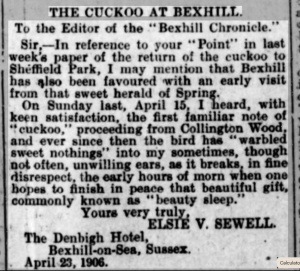
THE CUCKOO AT BEXHILL
To the Editor of the ‘Bexhill Chronicle.’
Sir,—In reference to your “Point” in last week’s paper of the return of the cuckoo to Sheffield Park, I may mention that Bexhill has also been favoured with an early visit from that sweet herald of Spring.
On Sunday last, April 15, I heard, with keen satisfaction, the first familiar note of “cuckoo,” proceeding from Collington Wood, and ever since then the bird has “warbled sweet nothings” into my sometimes, though not often, unwilling ears, as it breaks, in fine disrespect, the early hours of morn when one hopes to finish in peace that beautiful gift, commonly known as “beauty sleep.”
Yours very truly,
ELSIE V. SEWELL.
The Denbigh Hotel, Bexhill-on-Sea, Sussex.
April 23, 1906
What a sweet letter, I thought: Elsie in the spring of her life and so brimming with delight in the nature around her that it spilled over into a letter to the local paper—sweet enough that I forgave the tweeness of tone and even her ornithological faux-pas in describing the cuckoo’s call as a ‘warble’. With a little more research I established that she hadn’t written on a mere whim but as part of a tradition: in the early years of the last century hearing the cuckoo was news enough to warrant a letter to the newspaper. It even became a race of sorts in The Times, which printed the first such letter it received each year. Its verification process was found wanting, though, when in 1913 the honour was awarded to naturalist Richard Lydekker—adamant he had heard the cuckoo on 4th February. Seven days later, he wrote again, offering a sheepish apology:
I regret to say that… I have been completely deceived in the matter of the supposed cuckoo of February 4. The note was uttered by a bricklayer’s labourer at work on a house in the neighbourhood… I have interviewed the man, who tells me that he is able to draw cuckoos from considerable distances by the exactness of his imitation of their notes, which he produces without the aid of any instrument.
As I read this, a vivid memory resurfaced from 30 years ago. I’m about 14 and all of us—Mum, Dad, my brother Matt and me—are standing on the farm track outside our house. A family friend is with us too, though their face is lost to time. The chances are we had been playing cricket on the drive—milk churn as stumps—a favourite pastime once the weather warmed up. (I was never very good, possibly on account of my as-yet-undiagnosed eyes, but I took my turn.) It’s a fine spring day, and in the distance, across the fields towards Willow Shaw, we can hear a cuckoo.
Without a word, Dad steps off our ad hoc wicket into the gateway, half-concealing himself behind our front garden hedge, cups his hands to his mouth, and blows between his two thumbs. Cuuu—. He puffs again, this time raising a finger to alter the pitch. —Ckooo. It’s the perfect imitation. Straight away the cuckoo replies, then again, louder, and again, getting ever closer. Dad keeps going, and after a minute or two of this cranky to-and-fro the cuckoo sounds so close that—yes, there, right above us, that must be it—though who would have guessed its shape. It’s the most uncanny flypast: like a hawk but stouter, or an owl with a pigeon’s head. It buzzes us at close range, flapping and veering around in a flurry of confusion, then once more, before it realises the ruse and flies away.
We used to hear cuckoos every year, but that was the first and only time I’ve ever seen one. Dad never repeated the trick, not because it didn’t amuse him but because, I suspect, he didn’t want to disturb the bird whose seasonal routine was symbolic, if not sacrosanct. He had a deep, albeit discriminating, reverence for nature, especially the turning of the seasons. Observation is too slight a term for it; it was an awestruck appreciation akin to faith. He said as much himself: believing in the myriad ways the scene outside shifted through the year, and noticing the tiny details, was his religion. Why did he need God when it was miracle enough that, come April, buds would appear on the hawthorn—’cast ne’er clout till the May be out’—and, clout cast, the sun would warm his back as he stooped to dig another grave; and yes, the cuckoo would return, calling in the changes.
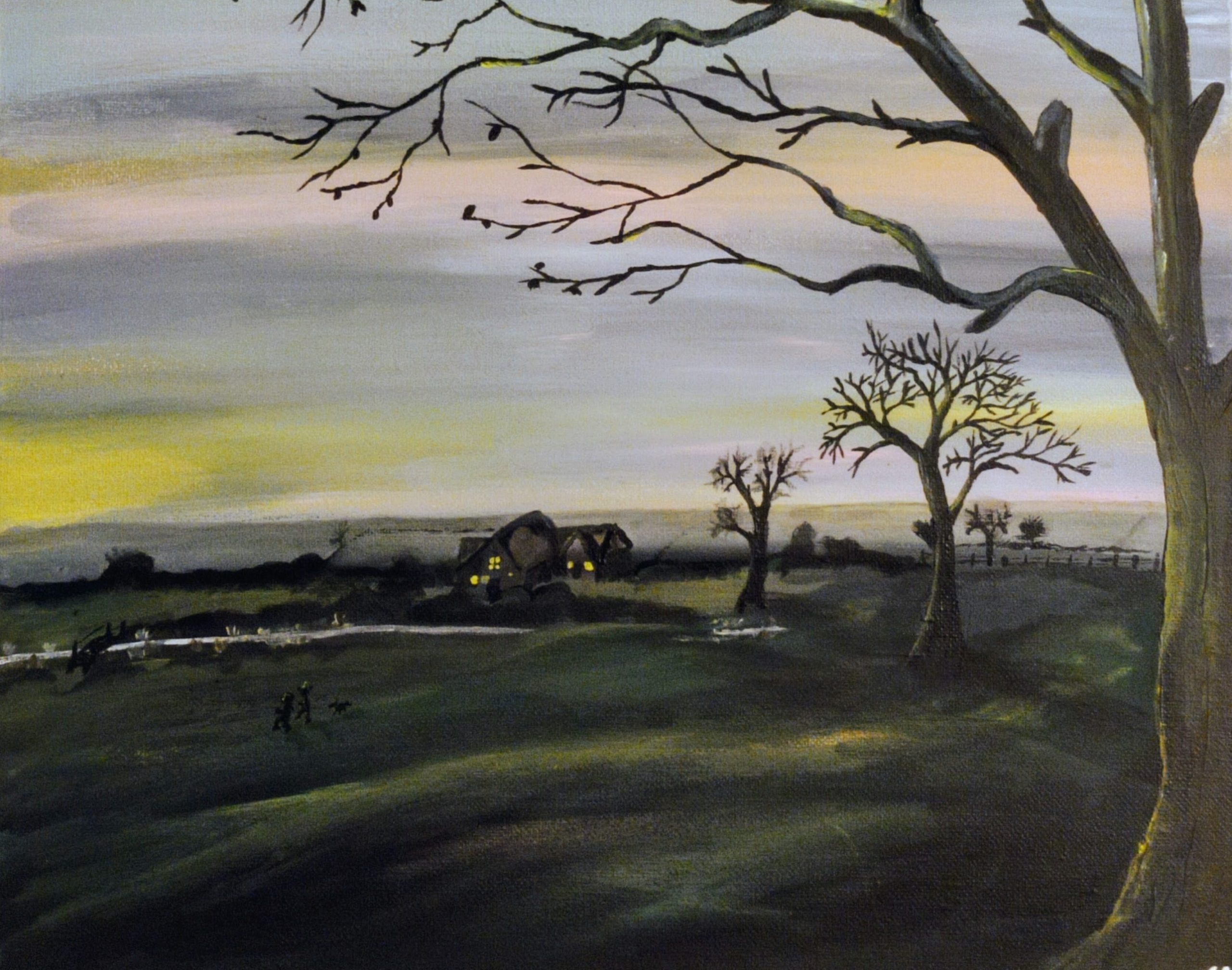
It was for the birdlife, in no small part, that he had, when I was eight, uprooted our family from our small-town semi to a remote new-build on the Sussex marsh. Back then, in the early Nineties, the surrounding fields plumed with great flocks of lapwing—that movie star of birds, with its eyeliner and quiff, and a buzzy, burbling call that sounded to me like Commodore 64 sound effects. He loved them so much he named our new home Plovers, in homage. When I say ‘discriminating’, though, I mean it in its harshest sense. While Dad would go to great lengths to protect one species—once offering to rebuild a barn just for the owls—against others he pursued merciless vendettas.
From the windows of Plovers, he would dote on his beloved species and take up arms against others. ‘Bet you ten quid I could get that corvid!’ Snatching up his rifle, he would ease open a window and take a potshot at a crow—and that was the least of it. The birds he most hated were the ones he deemed to be unfairly advantaged in the pecking order, too greedy or too cunning. Top of his hit-list were magpies, for stealing too many eggs, and sparrowhawks, for killing too many songbirds. Never mind that the pheasants he was rearing as a part-time gamekeeper wreaked far more ecological harm than any of the species he despised, the natural order was an order maintained by self-appointed ‘custodians’—countrymen like him.
Given his hatred of zoos and the keeping of animals in captivity, especially birds, Dad’s cognitive dissonance must have been working overtime when his war on magpies extended to using Larsen traps. A live bird is caged to lure in others: it flaps around, stressed out of its brain, in one half of a partitioned wire cage, while the two other compartments have spring-closing doors, propped open for visitors. One day Dad was fretting because he knew he would be too late home from work to check the trap. Being in my early teens and desperate to please him—despite, or because of, how impossible that seemed—I volunteered. (It helped that my brother was scared of birds: I knew he’d come with me, but I also knew he wouldn’t muscle in and take the credit.)
After school we walked across the fields and crossed the footbridge to the clearing between Willow Shaw and the badger earth where you’d always see magpies. As the trap came into view, it was worst-case scenario: not one trapped bird but two. Before I could think better of it, I opened the sprung door with one hand and reached in with the other, grabbing the first bird and pinning its wings. Then, as instructed, I lifted it out and brought it down hard, slamming its head against the top of the cage again and again until the life was gone out of it. The second bird, having seen its fate, wasn’t about to go easily. As I took hold of it, it opened its beak wide, craned its neck and clamped onto my index finger. Looking down into its determined black eye, I panicked, let go, and away it flew, free.
As we sloped home, full of dread, Matt advised that lying to Dad was too risky. He’d see signs in the trap—shit, tiny feathers, flecks of blood on the wire—and the consequences of being caught lying would be far worse than the fallout of handing myself in as a coward. I can’t remember exactly, but I think we confessed to Mum, who told Dad for us. He probably swore at her and raged about grafting all day while them parasites do nothing but take the piss. His usual routine. We all got the silent treatment for a few days, and as usual Mum bore the brunt. Parenting was her department, and one freed magpie was yet another exhibit in our, and therefore her, catalogue of failings.
The cuckoo is a brood parasite—meaning it lays its eggs in other birds’ nests—a term, had he known it, Dad would have used about us. Brood parasite: the perfect description of how he made us feel—like imposters in a nest he had worked so hard to build for himself and Mum. This was, no doubt, how his dad had made him feel too. Housed but not homed; lack of nurture by quirk of nature. He didn’t hate us, but he had no way of accommodating us within his clenched emotional programming. From inside the nest, you can’t see this. Instead, you look up at a man who is by turns principled, then cruel; reverent, then dismissive; and you try to assemble a person out of the pieces.
Each cuckoo is bound by its genetic code to a particular host species. A cuckoo that lays its eggs in a dunnock’s nest cannot look elsewhere; its eggs imitate those of the dunnock, preventing rejection. Each spring, having made the 5,000-mile trip from the Congo, each female cuckoo lays one egg in as many as 22 nests of that host species. The male, then, has a lot of inseminating to do, hence the relentless shouting out for it. Neither adult cuckoo will have anything to do with raising their chicks, leaving that labour to the hosts. Instead they refocus on recovering enough energy for the long flight back to Central Africa.
I’ve never felt moved to build a nest, to raise a brood of my own. I’d spend all summer cocking around, if I could—if I had the cuckoo’s brazenness. Queers went against nature, in Dad’s book, so I never told him. I’ve always wondered, though: didn’t he know enough about nature to notice that it could be very queer indeed? He had every reason to loathe the cuckoo, which—not unlike the magpie—exploits the hard work of smaller birds and gazumps them in their breeding. For centuries it was believed that, at the end of the summer, the cuckoo did not disappear but morphed into the sparrowhawk. Dad would never have believed it; he could tell the difference. He hated the sparrowhawk, but what he felt about the cuckoo I’ll never really know.
Another old prophecy he’d not have believed: stand stock still on hearing the year’s first cuckoo, keep listening, and the number of calls you hear is the number of years you have left to live. Given the chance, he could have kept it going, called back and eked out a few more, enough for an acre or two of old age. As it happened, it was in November—the cuckoos long gone to the Congo—that Dad, out shooting with his mates, was stopped in his tracks by a bolt of pain. The symptoms escalated over that winter, but it wasn’t until the new year that the doctors cottoned on: it was cancer, and it had spread right through him.
He wanted to die at home at Plovers; of course he did. But by early April he could barely stand and Mum was going through more than we could bear to imagine. When eventually he consented to the hospice, Matt and I helped him to his feet, and he wrapped an arm around my neck, pulling me in close as never before. I stiffened, not knowing what to do, how to be. It was strange to feel, only now, his physical form, what was left of it, the skin of his arm on my neck, his tall frame propped against me. Yet the weight of him was as nothing against the old expectation: even now, not knowing what he wanted. I felt his breath on my face and then came the hoarse whisper in my ear. I strained to listen, sensing he would not move until he had said what he needed to say. ‘What? I can’t hear you.’ He pulled me in closer still; another rasp of morphine breath. ‘But I can’t hear you,’ I failed again. This time he paused, did his best to fill his lungs, to muster voice, and slowly, one by one, we made out the words. ‘I. Won’t. Be. Coming. Back.’
Making sure we knew that he knew was vital to him, though I can only guess at why. He was saying, I suppose, that he was holding out no longer and, in so choosing, was leaving a free man—free, that is, from illusion and of his own free will. At the hospice, it was all over quickly. The angels of opium separated him from his pain, and he spoke no more. The next day, I hovered at the window as his breathing fell out of time and Mum held his hand, gently giving her blessing: ‘it’s OK, love, you can go now’. The significance of the date occurred to me only after I found his grandmother’s letter: 14th April, Sussex First Cuckoo Day.
I should have known this already, because just up the road from where we lived before moving to Plovers, there was a gap in the treeline where, as kids, we’d clamber down the embankment onto a disused railway, the Cuckoo Line. It was so called, I realise now, because the line’s next station was Heathfield, known to us as where Nan lived, but more widely known for its spring fair. Heathfield’s last passengers alighted in 1965, but people kept coming in their hordes for the fair. It dated back to 1315, when the Bishop of Chichester granted a charter for a weekly market and an annual fair to be held in Heffle (the town’s old name). The date chosen for the fair was St Tibertius’ Day, 14th April, when farm workers were given the day off to celebrate the arrival of summer. The town’s oldest woman was nominated Dame Heffle and tasked with the day’s defining act: releasing two cuckoos from a basket.
Her cuckoos were replaced by pigeons in later decades, but the old Dame kept letting summer fly until 2020. The ritual that had endured for 704 years succumbed, like so much else, to the coronavirus. I’d be a hypocrite to lament the loss of a country fair I never attended, but I can’t help wondering what is lost when we turn our backs on the turning of the seasons, except perhaps to worry Will it be too hot again? or Are those bluebells meant to be out so soon?; when a whole summer can pass without our noticing that we haven’t heard a cuckoo.
It isn’t only an attention problem, I learned, as I began reading about the cuckoo. Since we moved to Plovers in the early 1990s, cuckoo numbers in England have fallen by 70%, and plovers by almost 50%—both species are now on the red list of conservation concern. The coincidences, though, were singing ever louder, as I discovered that, in the same year my father died, 2011, the British Trust for Ornithology (BTO) set up a cuckoo tracking project, catching five male birds and tagging them with GPS transmitters. Their first surprise was that the tagged birds departed the UK much earlier than expected: they were gone by mid-June. Considering the cuckoo a British bird better describes our proprietorial tendency than it does the species’ whereabouts. It settles longest in the Congo, wintering there from October to February, but most of its life is spent on the move.
As I read on, I was delighted to find that the BTO’s project was not only still active but now had an expanded cohort of 11 cuckoos. It was while scrolling through the profiles as if on a dating app—each bird has a name (chosen by its funder), a photo and bio—that I found Sayaan. Sure, I was drawn to the unabashed stare of his bright yellow eye but, as ever in these matters, what really counts is location: he had been caught and tagged on the rewilded Knepp Estate, just 25 miles from where I live in East Sussex. Sayaan was the cuckoo for me, and if I was going to be sleuthing his every move, it felt only right to enter my bank details and sponsor him with a monthly donation.
Since mid-February, when Sayaan downed his last bellyful of Congolese caterpillars and began his long journey north, I have been transfixed by his GPS dot. At first he dawdled north, taking several weeks to exit Congo and clear Cameroon, but over nine days in early March he powered west, crossing Nigeria, Benin, Togo and Ghana before pausing in Côte d’Ivoire to gather himself. It was an edgy wait; what lay ahead didn’t bear thinking about. Then, on 8th April, I refreshed the map and could barely believe my eyes that his dot had leapt a full two inches. The relief! Sayaan had flown the full 800-mile span of the Sahara in a single 24-hour schlep and was now sitting pretty on the Algerian coast. (I scanned the scenery for him as I watched Meursault prowl the beach in The Stranger.)
While I waited for him, I read the research into why cuckoos have become so much less common in England. It’s a puzzle the BTO’s tracking project is slowly helping to piece together. Counter-intuitively, it’s not principally a breeding problem, or how they fare while here, but rather what happens afterwards on their journey back to Africa. A key factor—and another surprise—is that not all cuckoos follow the same route; some fly back via Italy, others via Spain. Of those taking the Spanish route (favoured by cuckoos that breed in southern and eastern England), more than half perish—including, in 2015, all of the tagged birds on this route. This particular corridor of peril is reckoned to be the single biggest cause of the cuckoo’s decline in England. Why Spain has become so inhospitable to cuckoos is unknown, but it’s likely down to climate change and degraded habitat. There is no denying the mad weather, the record high temperatures and wildfires. I also recalled, from autumn 2024, the shellshocked face of my colleague in Valencia as he recounted helping grieving neighbours shovel mud from their flood-wrecked streets.
Mercifully, Spain in springtime is comparatively benign, and another lurch of excitement came on 13th April, when Sayaan took off from Algeria, crossed the Med and made landfall just north of Castellón de la Plana, before touching down in the Spanish Pyrenees. The next day, Sussex First Cuckoo Day went unobserved, as Sayaan was still sunning himself in the Ordesa Valley. I didn’t mind; I was only glad he was safe and on his way. Four days later, on 17th April, he finally left Spain, flew across France, over the Channel, and landed back in Knepp. It was hard to resist the feeling, however mawkish, that he was finally home.
Raring though I was to see—that is, hear—him, crossing the county to Knepp would not be easy. My driving licence was revoked two decades ago—the DVLA taking a hard line on gappy vision—so I put out a call for help. By now I’d become a cuckoo-bore to all my friends, adding anyone who showed a flicker of interest to a ‘Sayaan Updates’ WhatsApp group. One such willing victim kindly offered to drive. So on the last weekend of April, there we were, sweeping the shrubbery like blind detectives, ears pinned. Over the next few hours we recorded all manner of calls—nightingales, woodpeckers, whitethroats, you name it—but Sayaan was keeping schtum. We’d covered much of the estate and were almost back at the car when—wait, what was that? Just one couplet of flutey notes, maybe two, but we were almost certain—until a collared dove piped up and cast us into doubt. Fearing we were going cuckoo rather than hearing one, we trudged in silence back to the car.
By the next weekend May had arrived and, in my head at least, Sayaan was now in full voice. Unable to contain our eagerness, my partner Anton and I struck out for Knepp by public transport: two trains and a mad dash for a bus, but we made it. The first bird we saw, straight off the bus, was a blackbird with a pure white head, which after a short debate we agreed was either a genetic glitch or a good omen. What followed, though, was another lengthy tour through a vast orchestra of birdsong without a peep from a cuckoo.
Several hours had passed and we were heading back towards the bus stop when our luck suddenly changed. The sound was faint at first but this time continuous, allowing us to walk towards it. Cuckoo—yes, definitely—cuckoo! On the path ahead of us stood a woman with a bicycle, gazing up into the trees from where the call seemed to be emanating. Another bike lay prone at her feet. As we approached, she looked around. ‘Cuckoo?’ ventured Anton, neither of us knowing how to sensibly abbreviate our reason for asking. ‘Oh no,’ replied the woman, ‘that’s my friend.’ She nodded up into the trees. ‘There is a cuckoo,’ she added, ‘but that was her. She’s trying to annoy it.’
Down the wooden steps from the observation platform came a sturdy woman with shaggy brown hair and an air of no-nonsense practicality. She looked at us frankly. ‘How do you do that?’ I asked, surprising myself, if not her, at my directness. Without replying, she took the bottle from her bike and squirted water onto her hands, which she rubbed, then cupped, together. Then, uncannily, did what no one had done since Dad on the driveway thirty years ago.
As we shuffled away in a daze of déjà vu, we heard another cuckoo call from off to our right. This one had to be real, as by now the impersonator was away on her bike. Instinctively we made towards the sound, scrambling off the path, through a gap in the trees and into a clearing. A few steps further and our feet were squelching into thick mud, beyond which lay a vast mangrove-like area of flooded scrub, enclosed by a tall fence. This must be where the beavers live. Keeping one eye out for furry forms in the water, we scanned the trees for the source of the sound. Sayaan didn’t show himself, but he was close now and he kept on calling, as if making up for lost time.
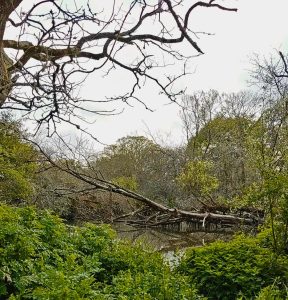
I don’t know how long we stood there, but by the time we dragged ourselves away we knew we’d missed the last bus home. It would be a long and expensive journey back, but neither of us minded. Was it actually Sayaan, the cuckoo we could still hear calling in the distance behind us? It may well have been, but if it wasn’t, it was no less glorious for not having a name or a leg-ring. Standing by the water filling our ears with that sonorous, insistent two-tone had reminded me of a fragment of poetry that Dad would often recite, apropos of nothing.
The sedge is withered from the lake,
And no birds sing.
He never read poetry, and the only books he owned were field guides, so he must have memorised it from a headstone. Roaming the cemetery reading the stones, mindful to stay out of sight, was how he passed the time while mourners lingered at the grave he was waiting to fill in. He had an ear for a good line, be it poetry or pop song, and this one became something of a mantra. It’s engraved on his own stone now, and comes back to me in unexpected moments, prompting me again to wonder what it meant to him. Was it the one epitaph, the one image of death amid all the sleeping and ascending he could not abide, that rang true?
Keats’s poem is about a knight who, having been seduced, then forsaken, by a fairy woman, loiters by the water awaiting her return. Whether he is dying or only bereft of desire, we do not know, and pointedly so, because the distinction has fallen away. Around him, it is not quite winter, and not quite nothing: the lake and the birds remain, but silent now, as if the world were holding its breath. This was its appeal, I suppose, to Dad: death not as erasure, but as a lack that is always also a lake, a scene that, even at its bleakest, quivers with a majesty no less real for having receded. For somebody, somewhere, summer will return, the sedge will wave its seedhead flags, and birds will sing for as long as the loiterer cares to listen.
The next morning, I’m woken by a scuffling sound, and open my eyes to assemble the pieces of a room gone awry; at the window, two bare legs beneath a blind tented over what appears to be the missing top half of a body. Anton has opened the lower sash as far as it will go and is leaning maiden-like out into the cold air. ‘What are you doing?’ I croak from under the duvet. ‘I thought I heard a cuckoo,’ he replies from outside. I don’t want to dismiss it out of hand, but wouldn’t it be too much? Twelve years in this flat without once hearing a cuckoo from the bedroom, and now, just hours after our county-crossing expedition to track down Sayaan—surely he’d dreamt it? ‘Pigeon, probably,’ I say by way of coaxing him back in. Finally he relents, untangles himself from the blind and climbs back into bed. As we’re settling back down, there it is, not close but too clear to doubt—cuckoo, cuckoo—from across the car park, somewhere in the trees beside the river—cuckoo, cuckoo—five calls, six at most, and then no more.
***
David Hinchliffe Bradford is a features editor and essayist based in Lewes, East Sussex. He is currently working on a book exploring how diminishing vision opens up new kinds of noticing. Read more of his work on his ‘Scintillating Scotomas’ Substack.
The image at the head of this essay is a detail of a painting by Izzy Bradford of Plovers, the author’s family home.
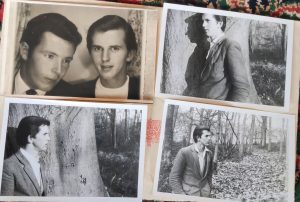
Photographs in the essay – a clipping of Elsie Sewell’s letter; the author’s father as a young man in the 1960s; the spot where the author listened to Sayaan – are courtesy of the author.